My best friend from childhood, Mary, was on a weekend trip with her best friends from high school when she heard about the death of her best friend from college.
Mary and Julia were the dream team of first-year roommates – instant friends with a bond that lasted 40 years until Julia’s way-too-early death. The devastating news came from a family member who reached Mary during a reunion with her high school friends.
Shortly after she got the call, Mary ducked out from activities with the reunion buddies and texted me. I called her and offered what condolences I could, frustrated with my limited ability to do anything to help heal her aching heart.
Before the day was out, I called my own best friend from college – just because. Talking to her that day was like patting my pocket to make sure my wallet was still there. Like Mary and Julia, Kim and I were friends from the day we moved into our college dorm. Kim and Mary were in my wedding. They danced at my daughter’s wedding reception. Julia and I were in Mary’s wedding. Kim and Julia met when Mary and I were on one of our occasional road trips.
Talk about a web of friendships.
This is what we celebrate Feb. 13, Galentine’s Day – the unexpected phone calls and the ones preceded by a text that says, “Can you talk?” or “I’ve been thinking about you. Are you OK?” We see acquaintances that started during a shared school bus ride or in a crammed dorm room – or a cluttered office or a beery backyard barbecue or a gasp-inducing workout – and realize they’ve transformed into the scaffolds that support us. We see cracks and mended places where we added new friends that have become as necessary to our well-being as woolen hats in a Central New York winter. We see where a friendship took a break for mysterious reasons and years later regained its energy when we realize the things we had in common transcended our youth.
These are the women who show up with a meal or a bottle of wine, a book or fuzzy socks, a phone call or the perfect meme at the right time. The ones who know better than to ask, “Do you need help?” They see the answer. And they know what to do about it.
So, here’s to the gals on this Galentine’s Day! My thanks and love to all of you!
The saddest part of the holiday season is packing up these gems.
Our Christmas tree is on its way out the door, all 7 feet of formerly sweet-smelling balsam. I am OK with it. I forget to water it after the first few giddy days, so it takes its prickly revenge on my hands in the first week of January as we heave it off the front porch on its way to the curb.
The ornaments are packed with just enough care to allow me to hope that they won’t shatter as their 25-year-old Rubbermaid bin gets shoved into the garage loft for another year.
The nativity scene is packed up with thoughts of how Ed’s mom started us on it the first Christmas we were married. Those sweet recollections are spiced with memories of the kids, at the height of their goofy teenage years, rearranging the figurines so they appeared to be high fiving each other with their prayerfully raised hands.
Our tree forest is stashed, too, packed with more care than the ornaments because it’s my second-favorite thing about our Christmas decorations. It started sprouting around a ceramic gingerbread house that was a gift early in our marriage. (Thanks, Karen K.!) It has since grown to 40 stems that spread all over the house, the prettiest part of our Christmas décor.
But not the best part.
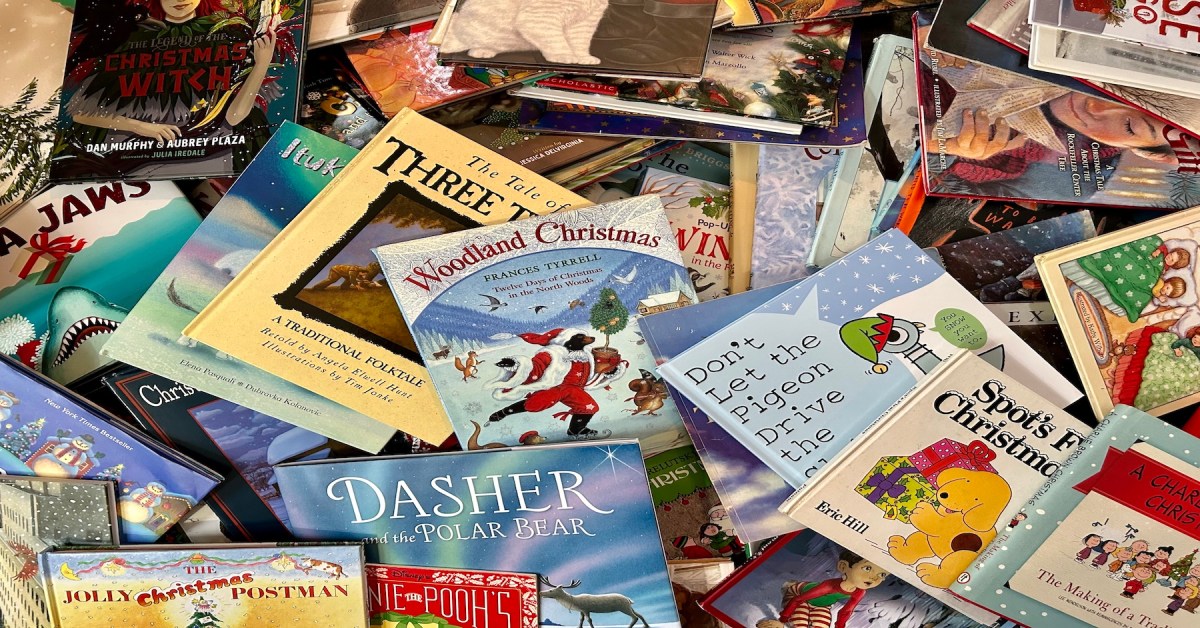
That honor goes to the Christmas books – all 76 of them.
Our holiday library began the month after our first child’s birth. We dashed out after Ed’s last law school final, 7-week-old baby in tow, to buy a Christmas tree late in the afternoon of Dec. 23. With the tree tied to the roof of the car, we stopped in the neighboring lakeside community for a fried fish dinner. We also ducked into a now-long-gone 5&10 for reasons we have since forgotten. With cash bestowed as a baby gift by Ed’s maternal grandmother, we bought little Bridget a pink knit hat and a copy of The Night Before Christmas by Clement C. Moore with illustrations by Arthur Rackham that first appeared in the 1930s.
Who knew what we were starting?
In the intervening 36 years, we accumulated Christmas books from friends and family. Then our personal “Santa” started adding a book every year. Along the way, as the kids got older lot of Christmas traditions lost their glow, as they do when children figure things out. But the growth of the library picked up steam.
Why did the collection of children’s books multiply faster when we no longer had age-appropriate kids? Because it was the one part of Christmas that mattered more to me than to anyone else. Among my generation and the ones that preceded us, holiday joy was typically orchestrated by women who somehow crammed the brewing of Christmas magic into days already brimming with childcare, family management, community involvement and professional careers. If we didn’t bake the cookies and deck the halls and buy the gifts, we felt we were leaving boxes unchecked, expectations unfulfilled. But one of the benefits of aging is caring far less about what other people think we should do. So, there are no cookies in my oven now. Fewer decorations hauled down from the loft. Fewer pots on the stove. Fewer gifts. But no less joy. And a lot more books.
You want classics? Come read The Gift of the Magi by O. Henry, illustrated by P.J. Lynch, or Christmas Day in the Morning by Pearl S. Buck with illustrations by Mark Buehner.
You like commercial appeal? We’ve got Disney, Pooh and the Grinch.
Do you want to be sad? We’ve got The Littlest Angel by Charles Tazewell, illustrated by Paul Micich, such a tear-jerker that I only read it to the kids once, more than 30 years ago. Feel free to come borrow it. Please. You don’t even have to return it.
Want nature? Look at The Snow Tree by Caroline Repchuk, illustrated by Josephine Martin, or Pick a Pine Tree by Patricia Toht with illustrations by Jarvis.
Are stunning illustrations your thing? Come read Dasher and the Polar Bear by Matt Tavares or Bright Winter Night by Alli Brydon with enchanting artwork by Ashling Lindsay.
Do you just want a laugh? Let’s read Santa Jaws by Bridget Heos, illustrated by Galia Bernstein, together.
Looking for something else? Maybe an unlikely heroine in Mrs. Claus or a shepherd girl? A story about plucky orphans, Santa’s sister or an animal that needs a home? We have them all. And more.
It saddens me to tuck them away in January. But it’s a comfort to know they will be back in their baskets by the woodstove in less than 11 months.
This is what life looks like lately. There are are worse ways to spend my time.
A spectacular wipeout on black ice – not 10 feet from our front door –- set me off on a slower start to 2026 than I’d anticipated.
After spending 2024 rehabbing a genetic (I think) sacroiliac (SI) injury that has plagued me since I was 16, I went full-tilt in 2025 doing the active things I love: ran the Syracuse Half Marathon again, waded into the murky waters of Onondaga County’s Jamesville Reservoir for open-water swim practice, churned my way 1.2 miles through the even murkier waters of Sandusky Bay as part of a relay team in the Ohio 70.3 triathlon, had a blast hiking a 20-mile Mammoth March with dear friends, wandered in Lapland with my childhood bestie and wobbled 25 miles on a new road bike that had spent 2024 gathering dust as my SI joint healed.
Then in December, I fractured two vertebrae thanks to arena-slick ice lurking in our driveway under a half-inch of Central New York’s trademark lake-effect snow. There went the four races I’d signed up for in 2026. There went winter spin classes on the bike. There went an aggressive winter swim plan and my twice-weekly gym workouts. And both my part-time jobs.
And part of my retirement identity. I was the one who just turned 70 and never stopped moving.
Yes, it is temporary. People suffer much worse and more painful setbacks so whining is, perhaps, undue. But at this age, putting life on hold for 12 weeks feels like losing a significant chunk of whatever good time is left to me. My self-diagnosed attention deficit struggles with being still.
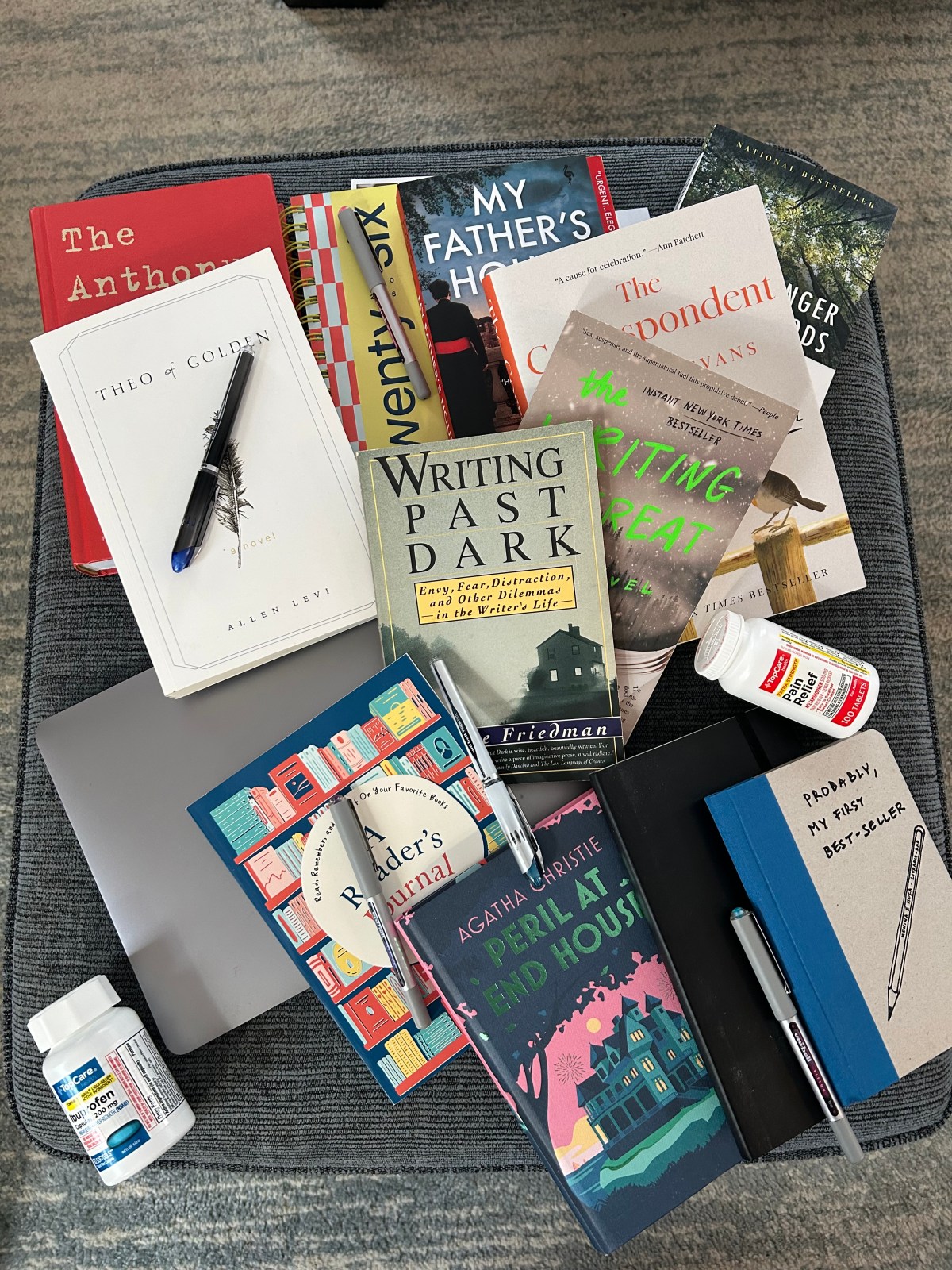
Within two days of my injury, books started piling up – some loaners, some gifts. My family and friends offered a long list of titles they had loved. By comparison, not a single person suggested a TV show or movie that I should watch to pass the time while my compressed thoracic vertebrae (T2 and T6 for the orthopedically minded among my readers) took their sweet time healing. My people know me well.
Then my friend Hattie made a suggestion that was one of the kindest compliments I’ve ever received: “Do what you do best. Write.” Thanks, Hattie!
So here I am. It’s time to get thoughts out of my head before it implodes. Writing my way out of confusion, anger and boredom is a habit that’s been with me as long as my SI joint has been a problem. I’ll inflict my words here on whomever cares to read them. If I’m brave enough, I’ll follow the advice of one of my sheroes, writer Anne Lamott: “You own everything that happened to you. Tell your stories. If people wanted you to write warmly about them, they should’ve behaved better.”
So, my project for 2026 is to shove some life into this blog. I am putting my intention here to hold myself accountable.
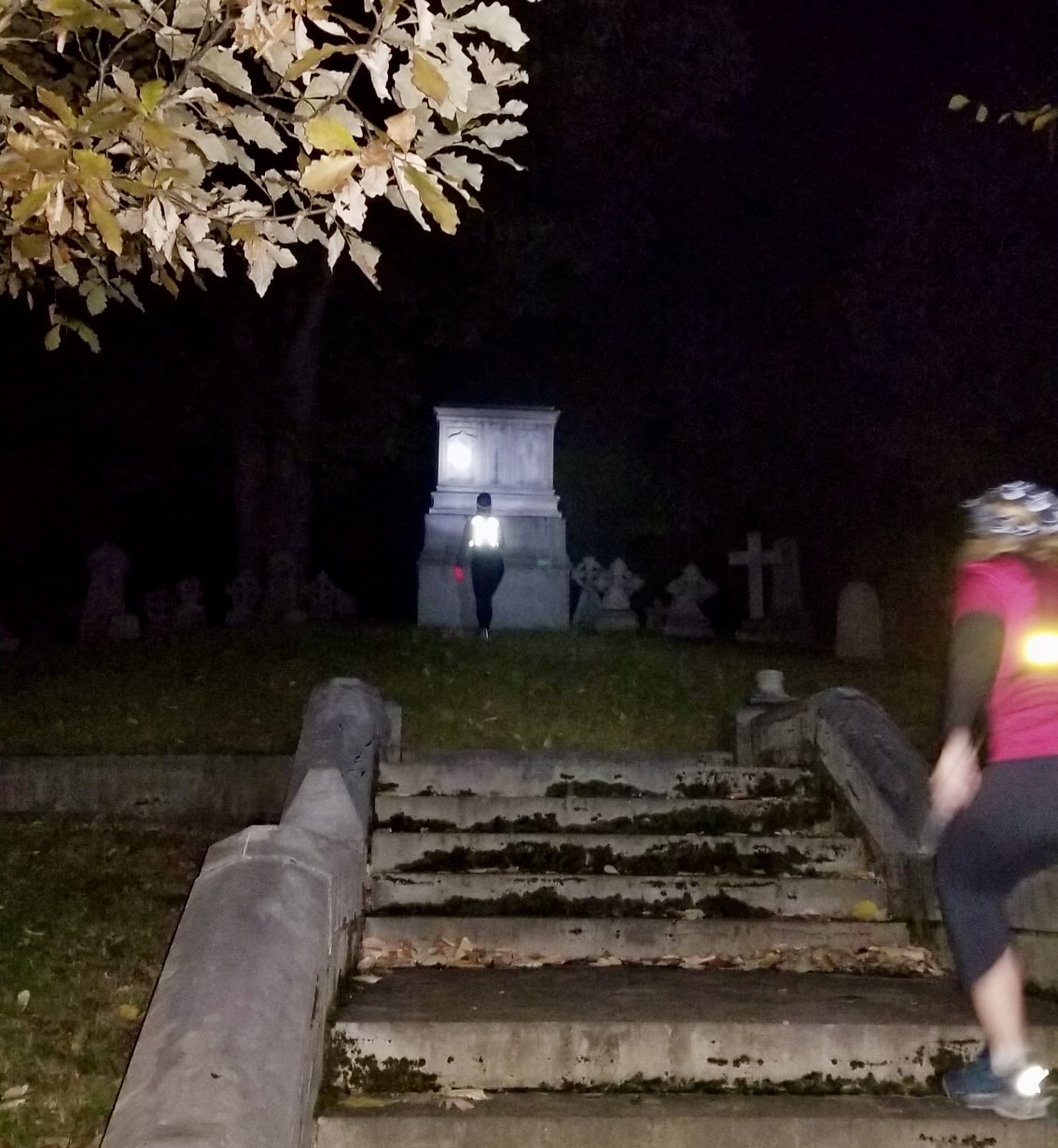
I’m the one at the top of the stairs in the reflective vest. That’s my friend and cemetery guide behind me, wondering what the heck I’m up to.
There was an evening in October a few years ago that was going to be fun no matter what. Fun is what happens when a half-dozen women who aren’t as young as they used to be dress up as zombies a few days before Halloween and go for a nighttime run in a cemetery that dates to the Civil War.
My running friends are prone to silly adventures. But, for me at least, that night was more eventful.
A lot of history and many stories reside in Syracuse’s Oakwood Cemetery. A former city mayor is buried there. So is a 14-year-old boy whose grieving family marked his resting place with a bronze statue of a lion. There is a person named Clemons, whose grave I encountered the day I took a lunchtime walk looking for a way to process the grief that all Bruce Springsteen fans felt after the death of his famous sidekick, E Street Band saxophonist Clarence Clemons. There is a man with the same surname as the best boss I ever had; I once snapped a photo of his headstone so my staff and I could torment the boss with it later.
Popular wisdom also says Oakwood Cemetery is haunted. I’ll get to that.
The night of our run, the six of us, complete with white face makeup and blinking skeleton necklaces (and, yes, reflective vests for safety’s sake), ran a few blocks through the city from one friend’s house and slipped into a secondary entrance to the sprawling old cemetery. Our university professor friend was our guide, pointing out historic headstones and mausoleums and sharing the stories behind them. We admired some architecture and learned some history, then paused on one of the curving, crumbling asphalt roads at the base of a small rise. I don’t know why I did it, but I told my friends, “I want to see who’s buried up there.” I ran up a path that led to a cluster of headstones. I stepped in front of them and looked at the one that had caught my attention.
Her name was CLAIRE. Spelled like mine.
I couldn’t hear my boisterous friends talking. I couldn’t hear the traffic a block way. I didn’t feel the nip of a Central New York evening in late October. I was only aware of Claire. I stared at her grave, ignoring the headstones on either side of it, waiting for whatever I was going to feel. It seemed like a moment for some Dickensian fear, like the whole Ghost-of-Christmas-Yet-to-Come thing might send me screaming back to the safety of my pack.
But that didn’t happen. My heart rate slowed, and I nodded slightly at the grave.
“It’s nice to meet you,” I finally said. “Thank you for saying hello. I hope you rest in peace.”
I trotted down to my friends, who were getting agitated about losing sight of me in a dark cemetery that has frequently been the site of minor criminal activity. They wanted to know what I’d been doing up there.
“I wanted to see that grave. It’s a woman named Claire. I think she wanted to say hello,” I told them.
There was some breathless disbelief from my companions who were full of questions, but I wanted to preserve my peaceful moment a little longer. I sprinted ahead of them, and they were gabbing about something else by the time they caught me.
People with knowledge of such things have reported signs of paranormal activity at Oakwood. The cemetery has been featured on hauntedhouses.com, and the local historic association sponsors ghost walks there. “Restive spirits,” they say. But there was nothing restive about my encounter with my Claire sister. It was gentle and peaceful. I was safe. My friends were nearby. And maybe a new friend was closer than I knew.
In the midst of graduation season 2024, I roll around in memories from way too long ago.
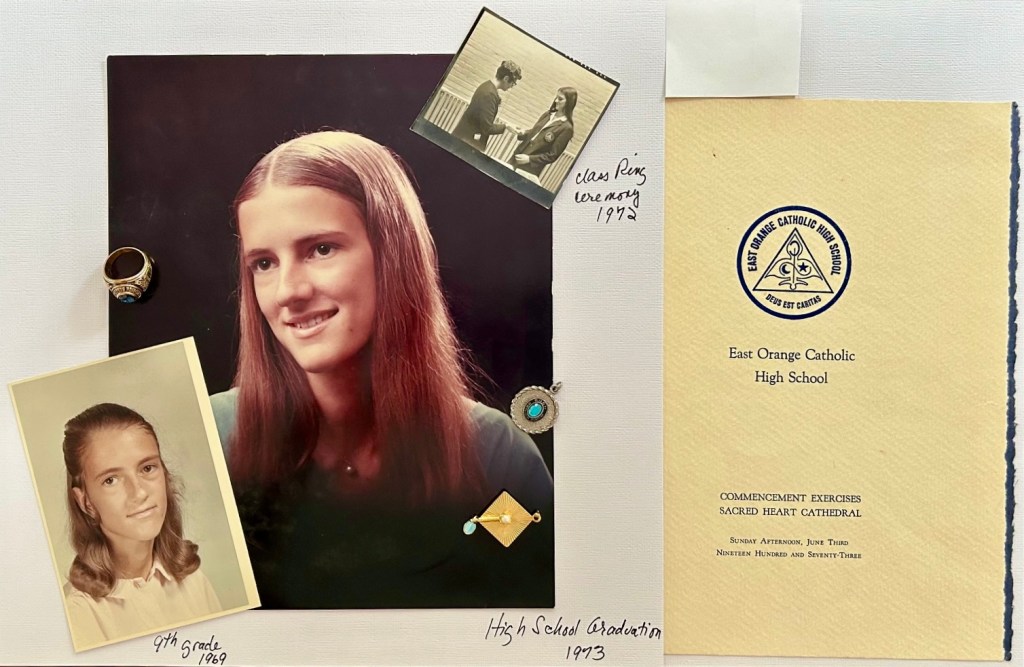
I have an unusual – and treasured – wine glass. It bears a line drawing of the Blessed Virgin Mary, whose haloed head bends toward a dove in her hands. Her robes fall in graceful folds. Beneath her image are the Latin words, “Funda Nos in Pace.” Lead us in peace. And curved around it is the name of an institution that was formative for me: East Orange Catholic High School, known to most everyone as EOCH (EE-ock).
I arrived at EOCH in the fall of 1969 after eight years at our parish grade school. Both my older brothers had gone on to an all-boys Catholic high school and the assumption was that I’d do the same, with the obvious substitution of girls for boys. In those days, we took a stress-inducing exam as eighth graders to see which Catholic high schools would accept us. I got into one that was too expensive, one that felt too provincial and EOCH. My future was sealed.
When I left elementary school at 13½, I believed my career choices were limited to occupations traditionally filled by women: teacher, nurse, secretary. My lack of patience, math skills and paperwork talents would have doomed me in any of those jobs. Even then, I knew that spending a lot of time at home was not for me. But I saw no evidence that girls could do anything else. I’d spent my childhood being told to line up behind the boys in the class, and to sit still while the boys got to serve on the altar during Mass. I’d watched a meaningless classroom election of officers devolve into a discussion of which boy would be president. Everyone knew girls weren’t presidents. Meanwhile, the outside world reflected the lessons I was absorbing about the role of women and girls – in those days, American women could not get credit cards separate from their husbands, attend Ivy League universities or serve on a jury in most states.
Then I walked into EOCH, where there were – no boys. We were hundreds of girls in battleship-gray wool blazers that sported the image of Mary and the dove on a front-pocket patch. In the warmer months we traded the blazers for pastel shirtwaist numbers we called “washerwoman dresses.” The school was run by the Sisters of Charity of St. Elizabeth, which traces its lineage back to St. Elizabeth Ann Seton in 1809. The sisters have never taken the education of women lightly. The order founded the first secondary school for young women in New Jersey in 1860 and the state’s first four-year liberal arts college for women in 1899. Today, the sisters list education, social justice and ecological integrity among their areas of focus. No wonder EOCH was a good match for me.
In an EOCH classroom, everything was a challenge.
From the beginning, it was clear my religious education would not replicate the Baltimore Catechism questions and answers of my parish school days. I don’t remember the name of the enthusiastic young religion teacher who held up a Bible and said, “You all know not to take the creation story literally, right, girls? You know it’s a story that’s meant to be a lesson?” I do remember the sudden feeling that it was OK to question what I’d always been taught; that the doubt that had nagged me since my first-grade religious instruction did not need to stay hidden.
I mentioned in a sophomore English class that I had read Gone with the Wind. The response from my teacher was swift: “You need to read Jubilee to get a different perspective.” As soon as I could get it from the library I read Margaret Walker’s novel, which uses the oral history of her family to give readers a realistic view of slavery in the American south. The look-at-both-sides lesson came in handy when I later became a journalist.
As a junior at EOCH, I rejoiced when our young history teacher, Susan Dominic Murray, who was the coolest member of the faculty, wrote, “Brilliant!” on the cover of my research paper about how the North won the Civil War. Despite the stellar review, she called on me to explain more about how Civil War bonds worked. She could tell by the way I had written about them that I didn’t know what I was talking about. So, I went back to the books – not to get a better grade, but to understand it because Mrs. Murray expected me to.
The other life-altering takeaway from EOCH came from the absence of boys. It meant girls were – everything. They were the achievers, leaders, artists, performers and athletes. They were also the clowns, troublemakers, slackers and outcasts. We really could do it all.
After four years at EOCH, I thought I could be anything I wanted. My thinking hasn’t changed. That’s why, last fall, I drove four hours south to New Jersey on a warm fall weekend for my 50th high school reunion. Between a Saturday dinner for our class and a Sunday afternoon all-class reunion, I reconnected with scores of women who had walked those halls with me.
I bought my wine glass. We sang our alma mater. We got teary over the searing loss of our beloved Mrs. Murray, who had gone on to a business career before she was killed in the World Trade Center on 9/11.
During my junior and senior years, after I broke out of the quiet bubble I’d been in for 15 years, Mrs. Murray often suggested I was louder than I needed to be and that if I wanted to succeed in life, maybe I should change my ways. It was distressing that she rolled her eyes at my laughing exuberance. But when you’re 16 and you discover that life is full of possibilities, it’s hard to keep quiet.
I saw Mrs. Murray at an EOCH reunion about 25 years ago. I didn’t think she’d remember me. When I reached the front of the line of former students waiting for a moment of her time, I smiled sheepishly and said, “Hi, Mrs. Murray. Don’t worry, I turned out OK.” She laughed and pulled me into a hug, saying, “Oh, Claire dear, I knew you would.”
Lucky day: Sarah, Melinda, me, Karen, Monica, Robyn and Joyce; my thanks to Della, too, who was with us every step of the way and snapped this photo a few minutes before I discovered I had lost my key.
Run for a while. Pat the pocket. Feel the key fob.
Run for a while. Pat the pocket. Feel the key fob.
Run for a while. Pat the pocket.
$#%!
No key fob.
Stress out. Envision a dreadful Sunday afternoon, given that you are at a state park 45 minutes from home with no way to start your car. Imagine finding a way home, juggling keys with your patient husband, trekking to the dealer and spending a lot of money on a new fob.
Move beyond stress to panic.
Then get lucky.
Get lucky again.
And again.
First, your companions all do a U-turn to come back and help, and you realize the worst part of this whole thing could be that you’re going to take up a chunk of their Sunday because none of them will leave until this is resolved. You frantically search your jacket while one friend pats you down to make sure it’s not tangled in your clothes, stuck to your skin (don’t laugh, that happened once) or caught in your shoe. One friend rifles through your hydration vest. Another thinks to ask a passing runner if she had seen a key fob on the Erie Canal path.
Lucky break No. 1: Yes, the other runner says she saw it 10 minutes ago and left it there, not wanting to move it from the path of any search party.
Every one of the women you’ve been running with turns to backtrack with you, ignoring your attempt to get at least some of them to abandon this mission and get on with their day. You contemplate the awesomeness of these seven runners who remain by your side in good spirits, while you retrace your steps.
Lucky break No. 2: You meet coaches from the university’s cross-country and track teams who know that their speedy young runners found the key a little while ago and tried to match it up with the cars in a distant parking lot. They tell you that when no car beeped in response, some of the coaching staff drove the university’s van to the state park, searching for the matching car. One coach assures you they will find your car and leave the key in it. He gives you his cell phone number, just in case.
Lucky break No. 3: A longtime runner from your training group is back at the park. He calls one of the friends who is with you to say he saw the university people in your parking lot and took custody of your key for safekeeping.
You and your companions run back to the park, having logged more than 8 miles instead of the 7 you planned on. You realize you’ve spent the morning with seven stellar human beings. You get your key back. You go home and text the university coach to tell him you’ve got your key, and that the morning was a great illustration of why you run — it’s the people far more than the miles. He responds that the running community must stick together and wishes you a great day.
You realize that you’ve already had a great day. At this point, anything more is gravy. Just like that extra mile you ran with your friends.
My thanks to the Syracuse Fleet Feet distance team, in particular my companions from that morning and Eric, who keep my key safe until I finished my run; and the runners and coaches from the Syracuse University cross-country/track teams. I promise my key will be in a zippered pouch from now on.
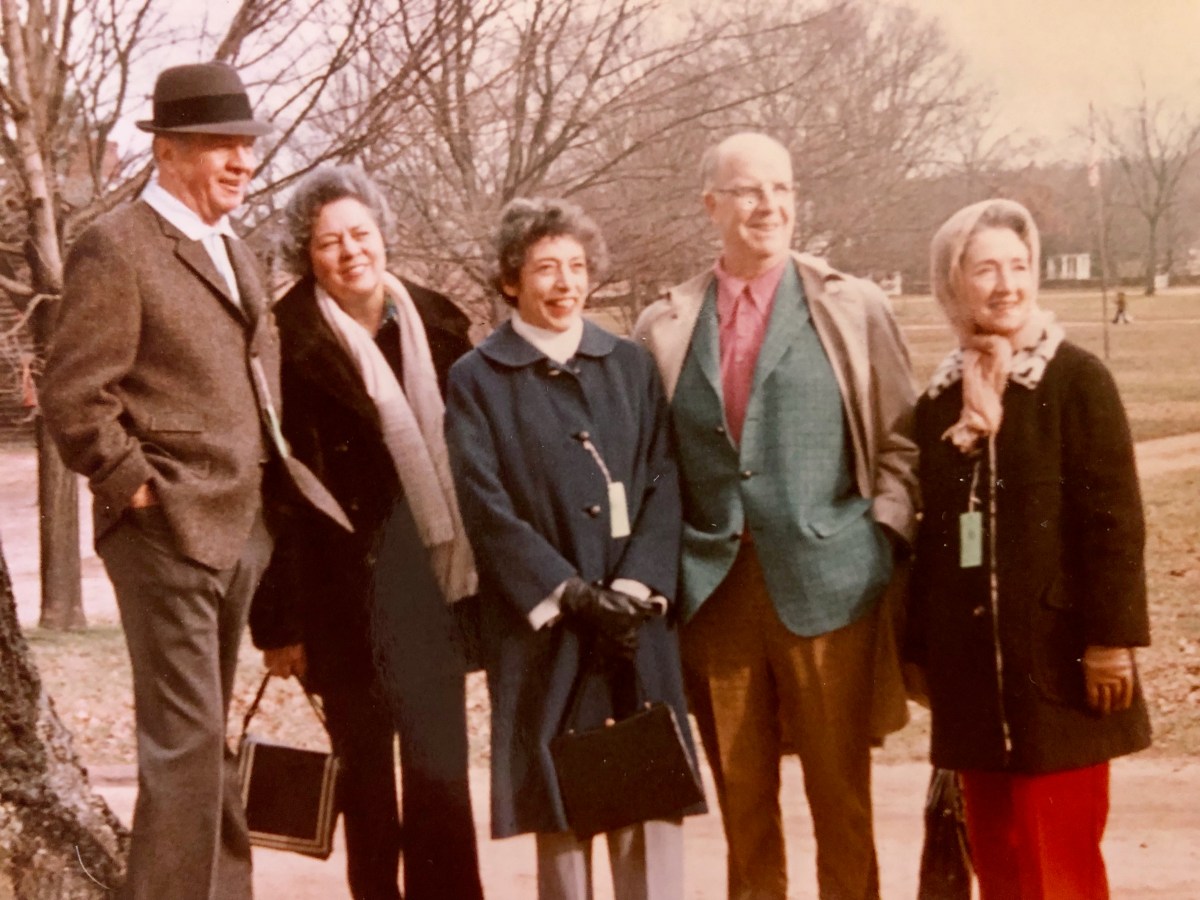
My mom is on the right. The lady who is second from left was probably the leader of the friend squad that set up the lunch the day of my grandfather’s funeral, eight years before this photo was taken.
One of my formative lessons in the value of female friendship came about because of a buffet lunch after a funeral.
The fare was predictable, given that it was the mid-1960s and this was a largely Irish-Catholic group of middle-class Americans in New Jersey: ham and cheese, hard rolls, butter, pickles, chips and maybe some potato salad.
And mustard in a short, delicate cocktail glass.
I was not yet 10 years old, but I knew those little etched glasses were used only on rare weekends for drinks I couldn’t have. Who puts mustard in a cocktail glass?
It turns out that if you’re lucky, your friends do.
It was my maternal grandfather’s funeral. The post-burial gathering was at our house. My mother was tending to my fragile grandmother, making the house presentable for guests and ensuring that the necessary somber clothes were clean and ironed. She couldn’t do the funeral home-church-cemetery circuit and set out lunch for a house full of people. So she called in her friends. While my family was sitting in the front row of chairs at the cemetery, three of Mom’s besties swept into our house with the no-fuss efficiency of middle-aged women who know they’ll get it right. They filled the ice bucket, and loaded the dining room table with sandwich makings, snacks, drinks and desserts. They set up the folding chairs in the living room and put the breakfast dishes away. Then they vanished, leaving the extended family to share lunch and memories together.
I waited until I was alone in the kitchen with Mom to point out that the mustard had been in a pretty cocktail glass. Her response has been with me ever since. “I guess the ladies couldn’t find anything else, so they used that.” Then she turned and looked right into my eyes. “Those are the kind of friends you want. You don’t have to tell them what to do. They just figure it out.”
Decades later, I recognize that as one of the best pieces of advice my mother ever gave me. And I’m happy to report that I did as she said.
So, on Galentine’s Day 2023, this is for the ones who did it all with me: laughed or cried, partied or panicked, wrote or ran, scrambled up a trail or screamed in the street. It’s for the ones who shopped for a dress with me or brought me a meal, taught me to cook or to drive a standard transmission, danced at my wedding or my daughter’s; for the ones who watched me take on daunting challenges and cheered me through every step.
One of the best things about being a writer is that it fits neatly with my Nancy Drew-inspired ability to overhear other people’s conversations without trying. I appear harmless. People say things when I’m nearby. I absorb those things and file them away in the weird catchall, file cabinet of a memory that is common among writers and editors.
Sometimes, these spoken words stick in my head and the only way to keep them from chewing holes in my brain is to share them. In chronological order, here are three recent favorites.
During my walk with Goose the rescue mutt on a sunny morning many months after Joe Biden was sworn in as president: Two older (than me!) ladies are chatting on a porch. One says, “Well, Trump needs these people. They have GOT to be on his side if he’s going to overthrow the government.”
At a gathering in a predominantly white suburb; the conversation turns to the city of Syracuse, 25 minutes away, where I worked and drove home at all hours of the day and night for 35 years, where a couple of our children live, and where we still enjoy dinners out and an array of events: “Well, you’re not going to go to downtown Syracuse without a gun.”
In a public facility in Central New York: A helpful staff member responds to a senior citizen’s question about federal incentives for energy efficiency. The staffer advises, “Be aware that all these federal programs could be suspended if we default on the debt.”
Patron: “Hmmph. More spending. That’s New York for you.”
Helper: “No, that’s House Republicans.”
Patron: “Hmmm…”
Here’s to being treasonous, fearful and uninformed.
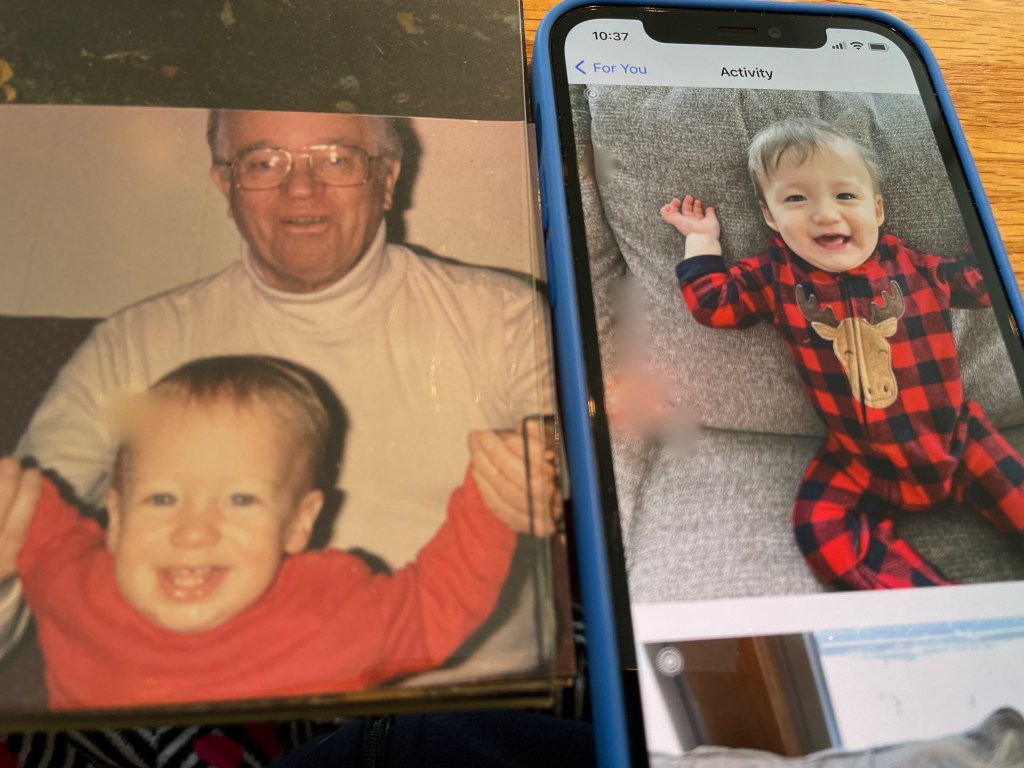
There’s an older man with a budding smile and graying hair brushed back from his temples. There’s a baby boy, not quite a toddler, with barely-there blond hair and a baby-tooth grin. They both wear turtlenecks. The bigger one is beige, the miniature version is bright red.
The man sits behind the little boy, holding his hands so he can stand upright. The baby is not an early walker. He is a precocious talker, however, and “Pop-Pop” is an easy addition to the first-year lexicon.
They both look straight ahead. Into the lens. The shutter snaps.
Within a few years, a heart attack takes the man, along with the memories he could have made with this grandchild and seven others. The grandkids are all young enough to be spared the sad duty of dispensing with their Pop-Pop’s belongings, so his two sons and his daughter handle the chore. They empty the apartment, donate the furniture, toss the papers. In his children’s homes, the things he passed on to them take on a new reverence – the family photos, the turquoise bracelet, the U.S. flag that draped his coffin.
The image of him with the baby boy ends up on his oldest son’s dresser, tucked in the corner of a mirror. This son, named Bob, like his father, has three boys of his own. Photos of the boys at every stage of their busy lives are all over the home Bob shares with his wife, Betty. The snapshot in the mirror is one Bob can’t miss seeing every day.
Now, nearly 30 years after his father’s death, Bob is the one called Pop-Pop. His youngest child, Steve, has a son, a fair-haired little guy named Jackson who is perpetually in motion, just like Steve was at that age. Steve takes a picture of Jackson when he’s 11 months old and texts it to his parents. Bob looks at it, points Betty to his dresser and says, “Look at this picture of Steve with my father.” The two photos make it clear to them that Steve and his darling son are lookalikes. Betty snaps a cell-phone image of the picture on the mirror and sends it to Steve so he can see how much Jackson looks like he did at the same age.
But Steve has news. He tells his mom he is not the little boy in the old photo. Instead, he was the photographer, snapping it with his Teenage Mutant Ninja Turtle camera when he was about 6 years old. Steve knows the baby in the old photo is his cousin, Patrick, whose mom is Bob’s sister.
Given their diverse genetics, it’s not likely that Jackson looks exactly like Patrick, his first cousin once removed. Maybe all big-boned, smiley, blond baby boys look vaguely alike. Or maybe we look at photos of people we love and see what we want. Smiles. Memories. Tradition. Family.
Betty shares the story with Patrick’s mom. The two women, sisters-in-law for more than 45 years, enjoy a laugh and commiserate about their inability to recognize their own children.
And Bob tucks the photo back in the corner of his mirror.
Post-pandemic re-entry has all of us facing the same horrible question: What have you been up to? My standard answer – “Oh, you know. The usual.” – might not work. How can you sum up 14 months of – whatever it’s been – in the answer to one question? Maybe I’ll just print this and hand it out.
When I thought it might last a few weeks, I filled two gigantic scrapbooks with family photos and painted a bathroom. When I realized it wasn’t ending anytime soon, I painted the bedroom our sons grew up in, touched up the trim in our daughter’s old room and did a thrifty redo of the furniture in both rooms. I painted the basement, ripped out the carpet with a friend’s help and updated the furnishings, largely by “shopping” our garage loft.
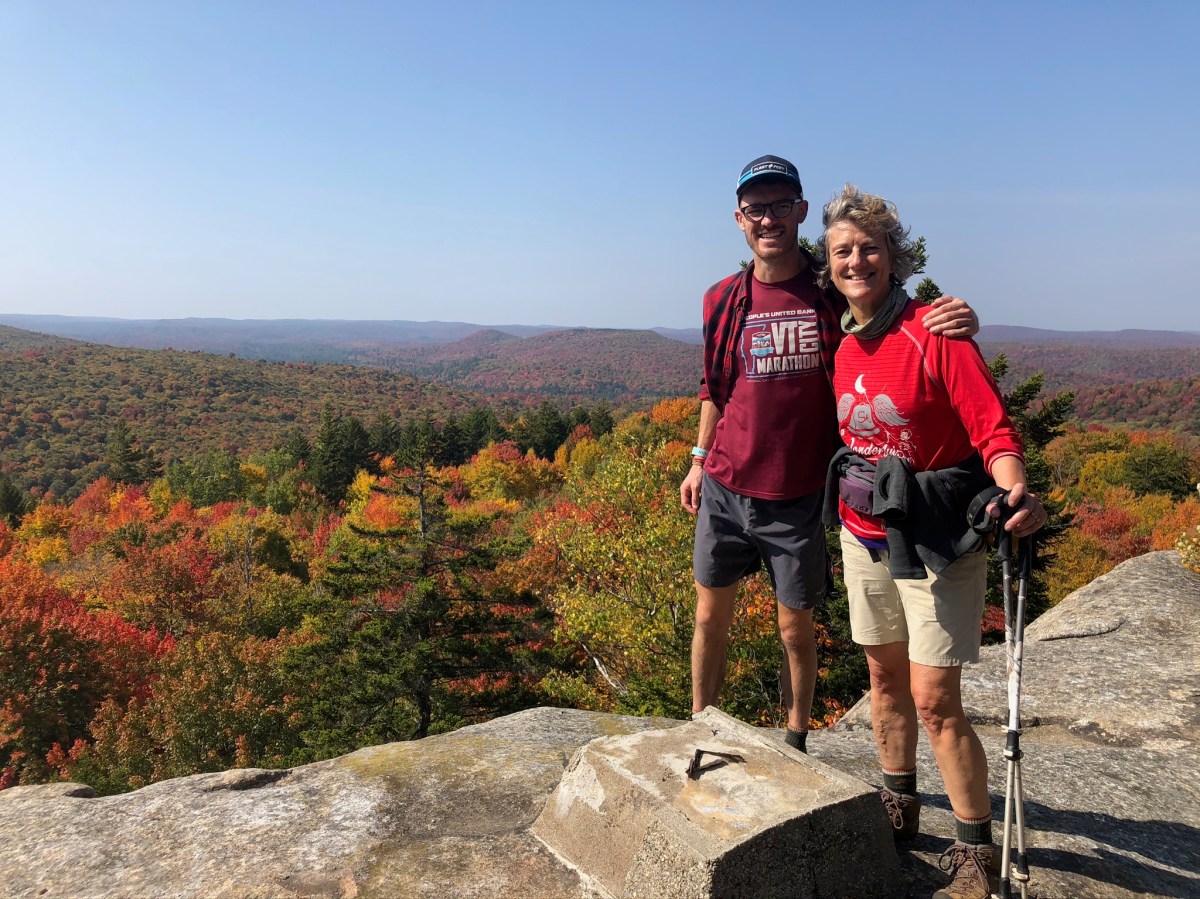
I should point out that I am not a homebody. I don’t love redoing rooms or hanging around at home. That’s why I ran 1,000 pandemic miles, including three versions of one virtual half marathon, and spent some long, dark evenings outlining cross-country road trips. On a glorious fall weekend, I went on my first backpacking trip in a few years, courtesy of our son the trip leader.
Ed and I partied with family in our daughter and soon-to-be son-in-law’s garage. We marked milestones from the appropriate distance: our younger son’s grad school graduation, some new jobs and related moves. At the same time, I missed our Seattle-area son and his partner with an ache that won’t go away until I see them again.
I finished reading The Lord of the Rings for the first time. I watched one eight-part series and two movies, more than I usually sit through in 14 months.
I cooked a lot. The new meal that emerged as the star was crunchy baked cod with homemade tartar sauce, New York City Marathon winner Shalane Flanagan’s red cabbage slaw and the best sweet potato fries I’ve ever made.
Except for the intense, early months of the shutdown, I kept up with my post-retirement mentoring job. I lost two freelance writing gigs when everything was canceled, then bounced back with a part-time return to the college, which needed a temporary science writer.
I wore the same wool dress 100 days in a row and documented it to get a gift card from the company. So maybe it’s no surprise that I decided no one needs 19 women’s-cut, graphic T-shirts, and 23 short-sleeve and 18 long-sleeve synthetic shirts for outdoor adventures.
I danced, toasted and talked about books at online parties. I learned that every time a group of my women friends gathers on Zoom, one of them can’t sit still and walks around the house with her phone in her hand, making me motion sick. Another will insist on sitting outside because it’s nice where she is, even though the WIFI reception is spotty on her deck and we keep losing her. And one of them will have a husband who lurks in the background thinking he’s funny.
So, what now? Some things, it seems, do not change when pandemics begin to lose their grip. I found more photos to organize. There are always more books to read and meals to cook.
But other things do change. There are road trips that require packing snacks and getting in the car instead of just poring over maps. There’s a wedding coming up. Family and friends are moving, retiring and reuniting.
Some changes, I’d like to hang onto: less busy-ness, fewer errands and more nights in my cozy tent.
Other changes, we can only pray for. God willing, there will be no more Zoom gatherings.


 Dunn Now